“Jared Kushner pulled out of a planned Trump-branded development in Belgrade,” The Wall Street Journal reported on December 15, citing a statement by a spokesperson for Kushner’s private equity firm. The spokesperson added that “meaningful projects should unite rather than divide,” allegedly taking into account the protests of the civic and professional public. In this way, the demolition of the General Staff building has, at least temporarily, been prevented.
The General Staff building was placed under protection as a cultural monument in 2005, exactly 40 years after it was opened for use. Protecting 20th-century architecture is a common practice in Europe. In the United Kingdom, for example, protected status is granted even to buildings constructed after 1945, particularly because the postwar period is considered a turning point in architecture. However, buildings built in the last thirty or so years rarely receive protection, as they have not yet stood the test of time, which may explain why the General Staff building was not protected before 2005 (a question some raise today).
Why do European heritage protection organizations consider the General Staff building a “masterpiece of Serbian, Yugoslav, and European modernist architecture”?
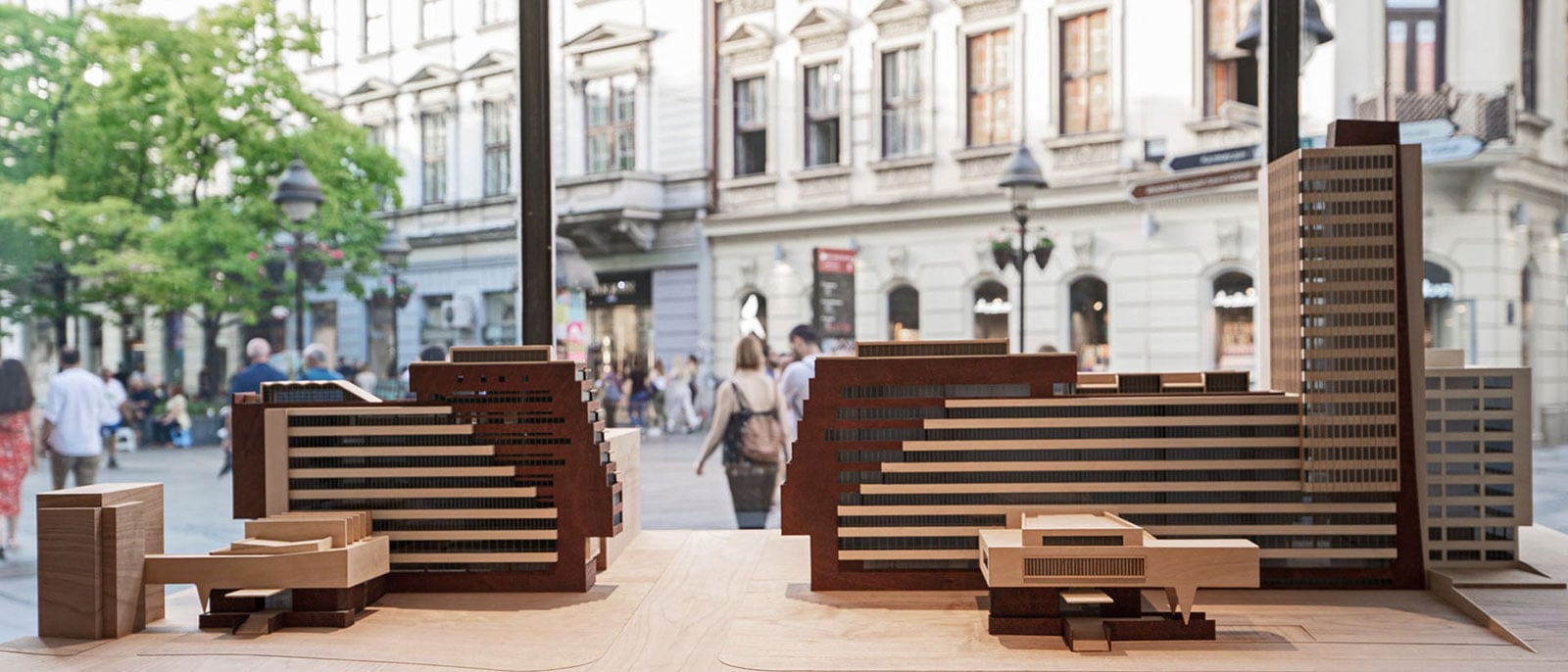
In the explanation of the decision to designate the General Staff as a cultural monument, it is stated, among other things, that “(the General Staff) is the only and most complex realization of the esteemed modernist Nikola Dobrović, who occupies a special place in Serbian and broader Yugoslav architecture. Through its expressive forms, as well as its urbanist layout and the power of the entire ensemble, positioned at the intersection of the city’s busiest traffic arteries, this architectural complex has become one of the most striking urban images of Belgrade.”
Its dynamic form, simple and asymmetrical geometry, and the bands of windows that wrap around the building, make the General Staff building one of the most representative examples of cubist-expressionist architecture in late modern Central and Western Europe. Yet what truly makes the General Staff building’s architecture distinctive is the way modernist principles were adapted to the local milieu in terms of urban configuration, use of materials, and multilayered symbolism.
Dobrović positioned the building back from the regulatory line of Kneza Miloša Street, thereby creating a public space that allows the architecture to breathe and gives passersby a distance from which to perceive the dramatic canyon of Nemanjina Street. The natural incline of Nemanjina Street further emphasizes the height of the artificial canyon, so that a pedestrian climbing from the old railway station is almost left breathless by its monumentality. In the opposite direction, when viewed from Kneza Miloša Street, the rhythm of white façade bands and windows reflects the dynamism of this important traffic thoroughfare.
Rough stone slabs from Kosjerić, dark red in color, give the entire complex its recognizable tone. They clad both blocks that cascade down toward Nemanjina Street, which, combined with the rawness of the semi-finished stone, creates the effect of a mountainous, rocky landscape. The slabs, 25×25 cm big, in concert with the white grouting, turn the façade into a modular grid, a method Dobrović used during his Dubrovnik period, but never in red. Contrasting the rough red stone is white, finished stone from Brač, which introduces horizontality into the composition and balances the intensity of the red mass.
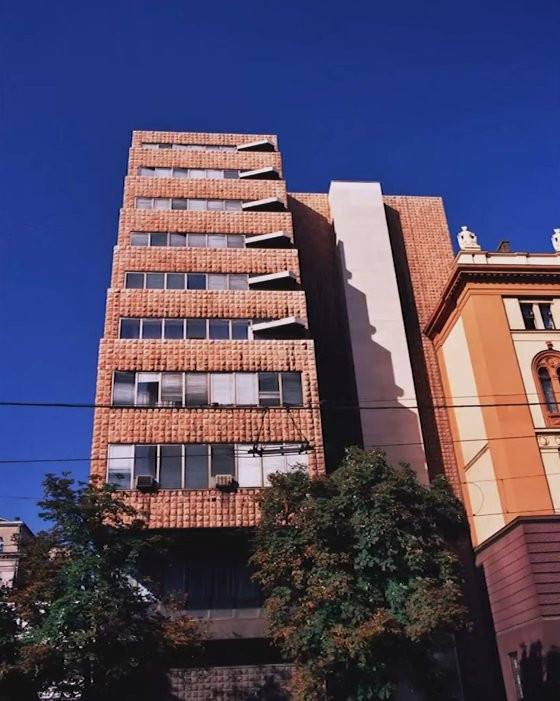
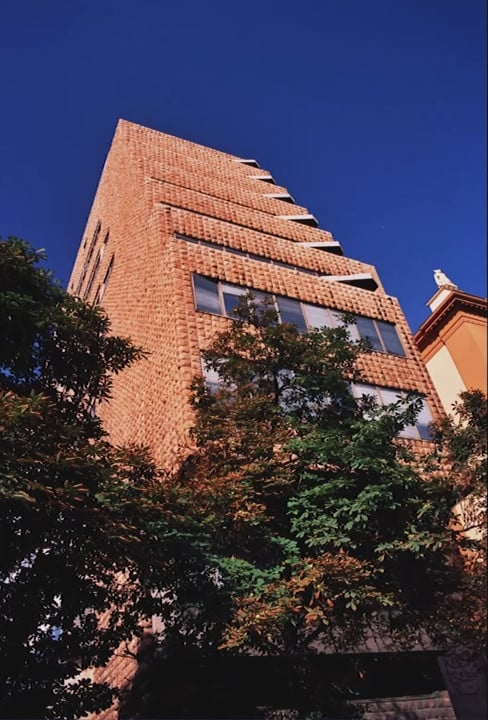
The authorities of the time did not favor Dobrović, which is probably why the General Staff building remained his only finished project in Belgrade, the city in which he spent the last 23 years of his life. The project was realized after winning a contest in 1953, in which ten architects from across Yugoslavia submitted their solutions under anonymous codes – among them Jože Plečnik, already well known in Europe at the time. The jury likely chose Dobrović’s proposal because it represented radical modernism, as Srđan Jovanović Weiss argues, in contrast to Plečnik’s neoclassicism, which Stalin had previously proclaimed the official Soviet style.
Soon after construction, two interpretations of the General Staff building’s form emerged. According to one, the dynamic relationship between volumes and large voids, or, as Dobrović called them, “spaces in motion”, symbolizes the philosophy of Henri Bergson. Because of its deep abstraction, this interpretation long remained a subject of debate among architectural theorists, without a clear consensus.
The second, much more obvious reading is that the cascades over Nemanjina Street evoke a canyon, leading some to recognize Sutjeska in them and to see a kind of antifascist monument to resistance and victory over a stronger enemy. Although Dobrović does not mention Sutjeska in his theoretical explanation, he states that the building is “a transmitter of all the important characteristics of a defiant and courageous nation.” However powerful this association was in the Yugoslav period, in the era of anti-communism it became something of a burden. In his award-winning essay Prostor u kretanju (lit. Space in motion), Vladimir Kulić rightly warns that, in the “current confused struggle to reconstitute a post-socialist Serbian identity, Dobrović is far too valuable to be discarded.”
After the NATO bombing, the General Staff building acquired a new, heavier symbolism. With its destroyed sections, the building calls to mind “a man lying down and trying in vain to get up,” a vivid metaphor Bogdan Bogdanović used in Glib i krv (lit. Mud and blood) to describe Sarajevo during the siege. Its ruined segments evoke the collective trauma of the recent past, as if constantly touching a wound that has not yet healed. Images of the demolished part of the complex have, for nearly 27 years, kept the citizens of Serbia in a space of unresolved trauma, persistently pulling them back into a past without an exit. Demolishing the General Staff building and constructing a hotel complex would represent a cynical commercialization of that unresolved trauma, while at the same time erasing layers of a complex and still living history.
On the other hand, the restoration of the General Staff building, which is technically feasible, could have a cathartic effect while preserving Dobrović’s masterpiece: through a public debate on the reconstruction, questions of the traumatic past could be opened, with the potential to release a part of that past’s burden, without it being suppressed or forgotten.
The author is an architect from London.
Translated by Marijana Simić
Peščanik.net, 10.01.2026.