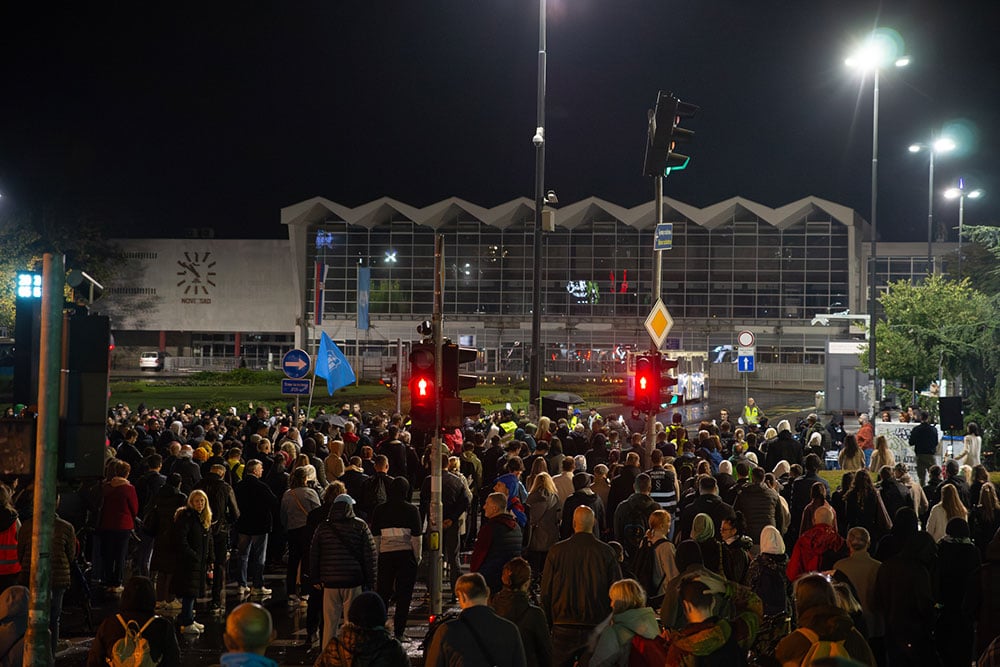
The European Parliament Resolution adopted on October 22, 2025, loudly and unequivocally expressed unreserved support for student demands and condemned the authoritarianism of the Serbian regime. The European Union – whose top officials over the past year have often oscillated between mild, declarative support for the protests and implicit support for the Serbian regime – has finally articulated its official position and definitive judgment on the student and citizen protests and the government in Serbia.
That this is undoubtedly true is confirmed unequivocally by the extensive Resolution of October 22, 2025, on Polarization and increased repression in Serbia, one year after the Novi Sad tragedy (2025/2917[RSP]), whose most important conclusions are presented below.
In the preamble, the European Parliament notes that:
– from February to the end of September 2025 more than 10 700 protests took place across more than 630 communities and 1 200 local community assemblies;
– previous elections were marred by pressure on voters, including local elections in Zaječar and Kosjerić, which were neither free nor fair;
– since late 2024, there has been an increase in violence and excessive use of force against protesters and political opponents, with more than 1,028 arrests and 340 violent incidents recorded;
– since August 2025 violence has further intensified, including police brutality, torture and sexual violence against students, and politically motivated prosecutions;
– in March 2025 protesters were attacked by a sonic weapon, with 3,400 testimonies collected despite official denials by the authorities;
– China’s presence and influence in Serbia has significantly increased in recent years through large-scale infrastructure investments, raising concerns about transparency, adherence to EU standards and environmental compliance, and the fact that the railway station project was carried out under a Serbia-China intergovernmental agreement, outside the scope of the EU’s ordinary public procurement legislative framework;
– the Serbian authorities have repeatedly stated that Serbia remains committed to joining the EU, yet the pace of progress in key areas, such as the rule of law, media freedom, judicial independence and the fight against corruption, has rather backtracked.
Having in mind all this, the European Parliament has adopted the 32-article Resolution, with the following key points.
The European Parliament:
– Reiterates its calls for full and transparent legal proceedings and examining more broadly the extent to which corruption led to the lowering of safety standards and contributed to the tragedy;
– Supports the right of students and citizens to peaceful protests calling for accountability and reforms which the European Union laso expects from Serbia;
– Condemns state repression and calls for urgent, impartial, and transparent investigations into all allegations of of abuse of force and politically motivated prosecutions; calls for the immediate release of opposition members held in detention and for an investigation into the responsibility of senior officials of the police protection service (JZO);
– Condemns retaliation against employees in the education and cultural sectors for supporting the protests, including job losses, salary reductions, the presence of police on university campuses and the withdrawal of funding for public universities;
– Calls on the authorities to immediately restore financing to universities and ensure the unhindered participation of the academic and research community in projects funded by the EU;
– Condemns the actions of the members of the ruling party in organising an illegal encampment in Pionirski park in front of the presidency building and is gravely concerned about multiple reports of individuals with criminal backgrounds being mobilised by the ruling party in counter-protest activities;
– Condemns the overt Russian Federation interference through disinformation spread by its officials, alleging that the protests form part of a Western-backed “colour revolution”;
– Remains concerned about the nationalist narratives present in parts of the protest movement and deplores the continued use of nationalist narratives;
– Reiterates that EU accession negotiations with Serbia should only advance on the basis of measurable and sustainable progress in the fundamentals cluster (calling especially for the immediate and full implementation of international election observers’ recommendations to ensure free and fair elections), and on full alignment with the EU’s common Fforeign and security policy, including sanctions against Russia;
– Calls on the European Commission to ensure funding and effective protection mechanisms for civil society;
– Supports the prompt deployment of an ad hoc EU fact-finding mission to Serbia, with the participation of the European Parliament, in order to assess the situation on the ground;
– Calls on the most senior EU officials to refrain from making unfounded statements praising the reform process in Serbia;
– Welcomes the shift in the Commission President’s tone during her recent visit to Serbia, which reflects a more accurate assessment of Serbia’s underlying problems and negative track record;
– Invites the Commission to launch an initiative for targeted individual sanctions to be imposed against those responsible for serious violations of law and human rights in Serbia, in line with the EU global human rights sanctions regime;
– Urges the EU Member States to adopt a united response to Serbia’s democratic backsliding, including by considering targeted sanctions against individuals responsible for serious violations of law and human rights, to strengthen protective measures for those at risk, and to closely monitor all ongoing legal proceedings related to the protests;
– Calls on all countries participating in Expo 2027 in Serbia to take into account the serious concerns and evidence of widespread corruption linked to the ruling authorities, as well as the reported lack of compliance with basic construction standards and legal requirements in the organisation and construction of the exhibition.
In conclusion, with this document the European Union’s position – previously (rightly) criticized as ambivalent – has become crystal clear: the Serbian regime is oppressive and authoritarian, suppressing the basic rights of its citizens – especially students and academic staff – who are demanding the rule of law, institutional independence, and social justice.
Equally important, the outcome of the vote (457 in favor, 103 against, 72 abstentions) sends a simple message: the previously lenient statements by Olaf Scholz, Emmanuel Macron, and Ursula von der Leyen toward Vučić do not reflect the opinion of EU citizens.
For those who were thus far disappointed by what appeared to be EU indifference, it is worth remembering that EU officials are merely officials—often willing to turn a blind eye when strategic, financial, or lobbying interests prompt them to treat Vučić favorably, at least until he delivers lithium from Jadar, money for Mirages, Serbs in Kosovo, and so on. To blame EU citizens for such “cowardly” (Žižek) statements is, in a way, similar to blaming Serbian citizens – who, according to numerous surveys, consistently and strongly support the students’ demands – for Vučić’s or Dačić’s words. From now on, the only official and confirmed representation of the will and opinion of EU citizens is this European Parliament Resolution, adopted by an overwhelming majority of their directly elected representatives.
The Resolution also recognizes the consequences of uncritical statements and unfounded praise of Serbia’s “progress,” calling on EU officials to refrain from offering symbolic support to an authoritarian regime. This should, therefore, put an end to frequent colloquial generalizations about the EU as a whole within Serbian public discourse – criticisms that were in fact based on the isolated and ambivalent statements of certain EU officials. And hopefully, it will also silence another popular complaint – that Serbian students are “Eurosceptic” or “anti-European.” After all, our students cycled to Strasbourg and ran to Brussels in search of justice and fairness – not to Moscow, Beijing, or Ankara. The thesis of student Euroscepticism is a propaganda tool in the hands of the President, who recently, alongside Ursula von der Leyen, portrayed himself as the guardian of Serbia’s strategic commitment to EU membership “until the next elections.” This thesis is certainly unfounded, given that support for EU membership among young people in Serbia is increasing compared to previous years. The main reason Serbia is still not an EU member, young people say, lies in the lack of democracy and rule of law.
European officials, one hopes, now fully understand that they bear a great responsibility to affirm and uphold European values before a determined generation of young Europeans – which Serbian students undoubtedly are – not only for the future of a Serbian society founded on shared European values but also for the re-legitimization and revitalization of the European project itself.
Likewise, Serbian students now have confirmation that the compliments, tears, congratulations, and greetings they received from citizens and local leaders along their Gandhian journeys to Strasbourg and Brussels were expressions of sincere and almost unanimous support from hundreds of millions of Europeans.
Resolution of the European Parliament of October 22, 2025, on Polarization and increased repression in Serbia, one year after the Novi Sad tragedy (2025/2917[RSP])
The authors are researchers at the Institute for Philosophy and Social Theory, University of Belgrade.
Translated by Marijana Simić
Peščanik.net, 28.10.2025.