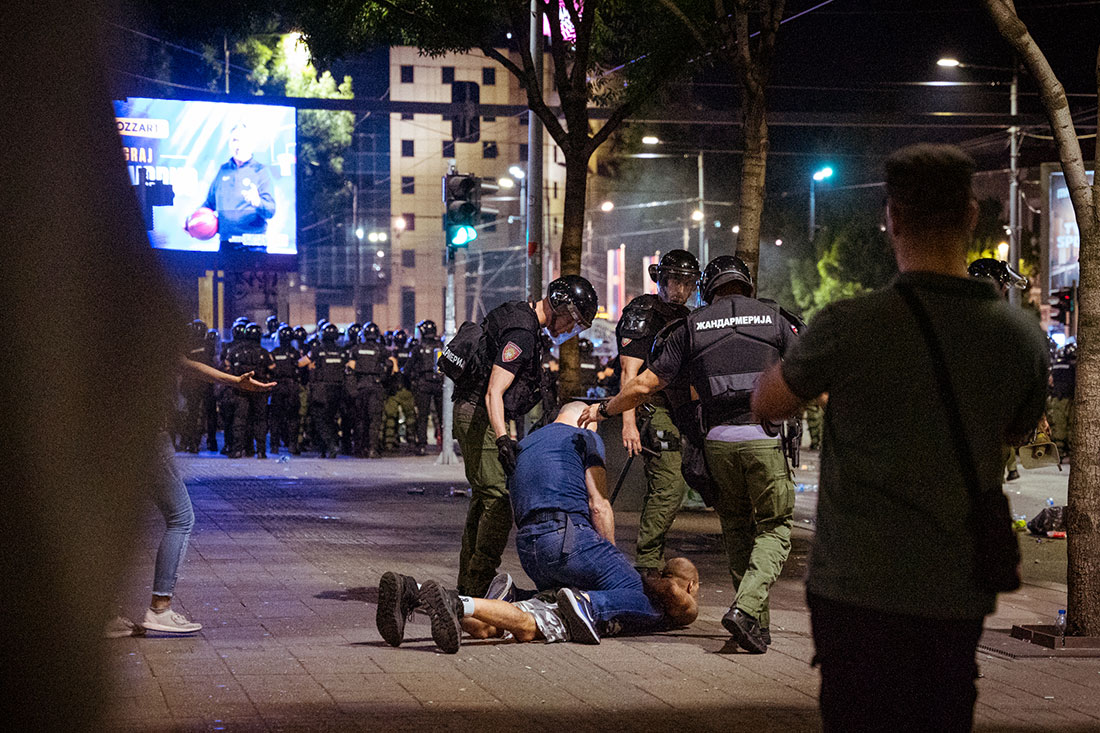
A few days ago, a video circulated on social media showing brutal police treatment of a young woman – a student of the Faculty of Dramatic Arts and a participant in the protest in front of the Faculty of Law in Belgrade – which attracted significant public attention.
In the video, while a female police officer is holding the young woman’s arms behind her back, a male police officer approaches and pushes her previously confiscated phone toward her face. The girl lowers her head, but the female officer forcibly lifts it again by yanking her hair. A second police officer also begins pulling her by the hair, while the one in front continues persistently holding the phone up to her face.
What can be seen in the footage is in complete, grotesque contrast to the statements given by high-ranking representatives of the Ministry of Internal Affairs and the police in the days that followed, claiming that the Serbian police had responded to the protests in a manner that was “more than tolerant, patient, composed, calm, and strictly in accordance with the law.” It is plainly obvious that the behavior of the officers in the video bears no resemblance to those claims. The hair-pulling, along with previously slamming her face against a metal bench, evokes entirely different, far more disturbing associations.
According to the Law on Police, officers are required to submit a written report on any use of force as soon as possible, and no later than 24 hours after the incident. The report must include information about the means of force used, against whom, the reasons and basis for its use, and any other facts relevant to assessing the justification and legality of the action. It would be truly interesting to see what these officers would write in such a report. But realistically, that’s unlikely – this legal obligation seems to have been reduced to a mere formality, and most likely completely neglected in practice.
The footage inevitably points to abuse – behavior that violates human dignity. This raises serious and legitimate suspicion, which the public prosecutor must investigate to determine whether, beyond the obvious violations of professional standards defined by the Police Law and the Code of Police Ethics, there are also grounds for criminal charges under Article 137 of the Criminal Code. That article states that “anyone who abuses another person or treats them in a manner that offends human dignity shall be punished with imprisonment of up to one year, and if done by an official in the course of duty, up to three years.”
A responsible prosecutor should not stop there. There are additional concerns that also need to be addressed.
The Constitution (Article 41) guarantees the inviolability of the confidentiality of communication. Exceptions are allowed only for a limited time and only based on a court decision. Therefore, while the police may, under legally defined conditions, temporarily seize a phone, they are not allowed to inspect its contents without a court order, nor may they demand that the person unlock the device, let alone force them to do so. Everything seen in the video makes it more than plausible that the officers were attempting to force the girl – whose phone could be unlocked via facial recognition rather than a numerical code – to unlock the device. This raises a well-founded suspicion that a crime under Article 142 of the Criminal Code may have been committed, which prescribes a sentence of up to two years for unauthorized violation of the confidentiality of electronic communications, and up to three years if committed by an official in the course of duty.
The individuals directly involved in what was seen in the video must be held accountable, as should their superiors who failed to prevent such behavior – or possibly even encouraged it. Unlawful use of police powers, according to the Law on Police, constitutes a serious disciplinary offense. So does the issuance of unlawful orders.
The prosecution has stated that “a case has been opened and is in the stage of review and verification.” However, this gives little reason for optimism about the outcome. The prosecution was compelled to “open a case” only because the Belgrade Centre for Human Rights filed a formal criminal complaint. But it’s well known that investigations against officials for various forms of abuse of citizens are routinely delayed or handled negligently. The passivity of public prosecutors in most such cases indicates a barely concealed intention to let the statute of limitations expire.
Many extreme cases of brutal abuse of citizens have ended without any meaningful outcome. In none of the numerous serious cases during the 2020–2021 protests was anyone held accountable – or even investigated, most likely. There are more recent examples too. More than a year after a man died as a result of a brutal beating while in custody at the police station in Bor – an event authorities tried to falsely present to the public as a natural death – no one has been held accountable. Several months have passed since the severe beating and injury of a detainee in a Novi Sad police station, with no consequences. Similarly, nothing has come of the bizarre suicide by hanging of a detainee in a police van, despite the fact that his hands were tied behind his back.
This grotesque “system” and practice – where an arrogant “elite” and their obedient followers act with impunity – stands as the complete antithesis of a normal society. It implies an ever-increasing risk of new, tragic consequences. Changing this is not just a matter of legal principle, but a vital existential interest for the vast majority of citizens.
Translated by Marijana Simić
Peščanik.net, 16.07.2025.
- Biografija
- Latest Posts
Latest posts by Rodoljub Šabić (see all)
- SF ili kriminal - 14/09/2026
- Tužilaštvo ili simulakrum - 09/09/2026
- Prozirne kabine - 03/09/2026