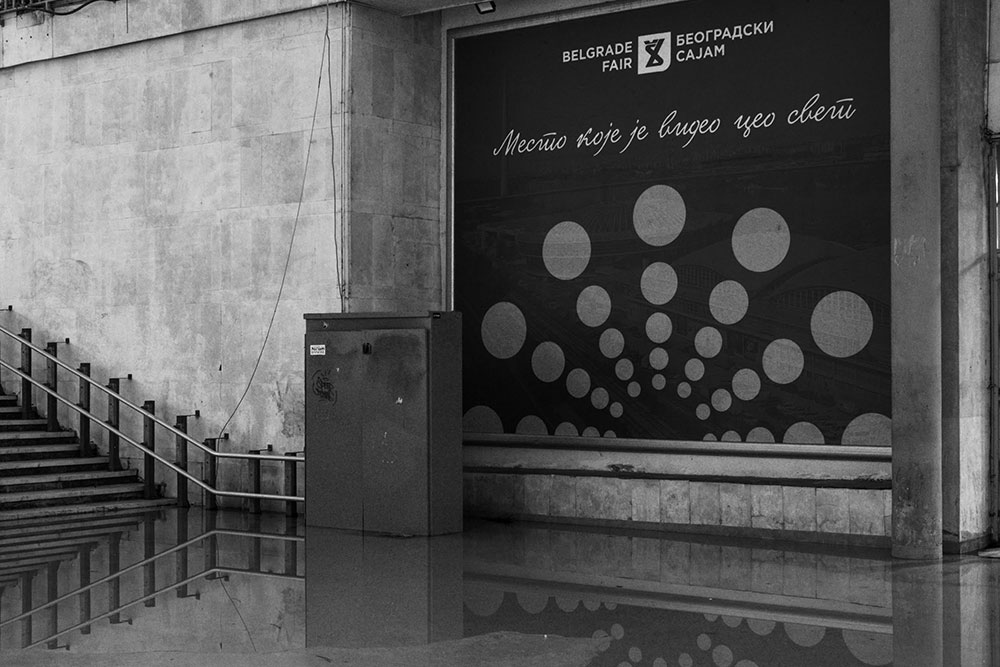
The hallmark of the Book Fair since the SNS came to power is the war criminal Vojislav Šešelj – or rather his oeuvre: the one-hundred-volume annals of the Serbian Radical Party. The approach to the Fair itself, the entrance halls, are covered with his billboards. On the other side are promotional posters of Ljiljana Habjanović Đurović, who sums up the political influence of the SPS and the Serbian Orthodox Church. These are clear signals of the cultural policy the Ministry of Culture set out almost ten years ago. Within this ideological field unfolds the most important fair in the country called the Belgrade International Book Fair. Or, affectionately: “The holiday of the book”.
During preparations for this “holiday,” over the last 11 months of our discontent, the Book Fair Committee led by Dušan Kovačević did not pay much heed to our social and political reality, but carried on, as if nothing particular were happening in the country. In the end it turned out that the Fair had gotten stuck in the same mire into which Aleksandar Vučić has led the entire country.
Now, the central question is whether to appear at this year’s Book Fair or not. If that were somehow resolved, it seems everything would be much simpler and society as a whole would be closer to defeating the dark forces of the regime. Some publishers remembered two days before the “holiday of the book” that it would be impolite to celebrate on November 1. From the outside, it looks as if the entire publishing world was asleep for 11 months and suddenly woke up, glanced at the clock, and realized they were late for work. In other words, they realized the Fair this year is being held from October 25 to November 2, which includes the anniversary of the collapse of the canopy at the Railway Station in Novi Sad, when the biggest commemorative gathering in that city will be held – an event that could disrupt the Saturday economy of the Fair.
The SNS Book Fair has imposed an ideological yoke on publishers and buyers alike, one everyone has eagerly yoked themselves to and has continued to pull forward even harder, hoping to still sell or buy certain books. That yoke represents the ideological ballast of the 1990s, clearly visible at the Book Fair. In this small space, all the semantic markers important for reading the model of our society are visible. That primarily means the presence of symbolic nationalist matrices whose generators are the SNS, SPS and the Serbian Orthodox Church. There is a noticeable dominance of narratives related to the defense of Kosovo and Metohija, denial of war crimes, failure to confront the past, the apotheosis of the army, the police and, of course, the Serbian Orthodox Church — which since the 1990s occupies a large part of Hall 4 and Hall 2. Special status at the Fair, apart from the guest-of-honor country, is given to books written by war criminals such as Veselin Šljivančanin, Dragoslav Bokan, Radovan Karadžić and similar “writers.” There is also literature about war criminals written in a laudatory, mythopoetic key. Their authors are historians and publicists. A portion of the reading public consumes this material as unquestionable testimonies about how it all really happened, as Mirjana Marković – whose books are also sold at the Fair – would say. There is no doubt that the SNS will soon bless us with new volumes by Nebojša Pavković, who has just been released from prison.
The segment of the Book Fair that tries to present all this ideological baggage under the guise of pleasant conversations about “the current challenges of literary creation, as well as social questions that shape today’s literature” is the infamous Fair cultural program. For years it has been thoroughly cleansed of all relevant authorial voices from Serbia, as well as undesirable panel topics. This year’s slogan is “Your new story,” which, according to members of the Committee, should “evoke the constant searching and waiting, joyful anticipation for each Fair and an active life between two Fairs.” Such a cynical slogan, as well as the whole concept of feigned joy in a society that is actually in deep sorrow, was not conceived in September or October of this year but much earlier, just as the dates of the Fair were scheduled back in April. It is reminiscent of treating trauma with folk music, an approach the Government of the Republic of Serbia infamously tested on children who survived the massacre at the “Vladislav Ribnikar” primary school. It is actually a masking of society’s trauma that is supposed to be accepted as part of the political program of an incompetent president of the Republic.
In general, the Book Fair did not suddenly become what it is this September; this has been happening before our eyes for years. After all, no writer who in recent years had the honor to hold the welcome speech at the opening of the Fair has commented on the real problems of cultural policy and a society sinking into ever deeper crisis. From admiration for civilizational wisdom to a glorification of words and magic under the Fair domes — we heard everything but reality. And as the crisis deepened, writers’ opportunism grew and then escalated in the years of the massacres in Ribnikar and Dubona, and especially after the collapse of the canopy in Novi Sad. Eventually, we reached the joyful anticipation of November 1 in the spirit of Fair magic. But this should not surprise us, since most writers have never been on good terms with a rebellious society.
If we recall the Paris Commune as a paradigmatic uprising of society against the machinery of power, we can easily reach the positions of writers whose works today are indispensable in the canon of not only French, but also world literature. Flaubert was horrified by the demands of the Paris Commune, especially universal suffrage and compulsory free education for all. “What is this,” fretted the author of Madame Bovary, “what difference would remain between the rich man and the worker, since both would be able to read the same newspapers?” Anatole France called the Commune “a furious madness,” and Alphonse Daudet showed the deepest contempt for workers, whom he regarded as “always drunk, liars, thieves who beat their wives.” Even Victor Hugo did not initially sympathize with the Paris uprising. He accused the insurgents of provoking riots and brandishing coat racks in front of the National Archives, calling for the ringleaders to be punished. Only after the brutal reprisals by the authorities against the rebellious society and the Bloody Week did Hugo begin to see that the main cause of the uprising had been poverty — destitution that the literate representatives of the bourgeoisie could barely imagine. Zola was of similar temperament; he would later publish Germinal, surely under the lasting influence of the Commune. If writers had had their way, we would never have achieved the right to education, to health care, to the vote, or to women’s equality.
Likewise, the current dilemma over the Belgrade Book Fair will not be resolved by writers or publishers — least of all by an out-of-tune Committee. It will be resolved by a rebellious society that has a very clear idea of what November 1, 2025 should look like — far from the SNS’s desired ode to joy. The reaction of the rebellious society will affect the entire economy of the Fair, as well as the book market, and especially the status of certain publishers and writers in the near future, after the fall of the regime. We are reassured of this by the persistence of the Resistance Movement in Serbia, which has outgrown the Student Protest and is now rolling inexorably towards a single goal. The number of arrested citizens has long since exceeded 1,000 people. There are no statistics that would tell us the number of injured, broken, humiliated, those who have been fired, those denied medical treatment, those deprived of the right to speak publicly, those left without means to live. For a year now the rebellious society has rallied around demands for accountability for the murder of 16 people in Novi Sad (and one terribly injured person). The next wave of organization began after the green light was given at Slavija on June 28. The most recent wave came in a spirit of solidarity with those unlawfully deprived of liberty. The wider wave established a connection with rebellious parts of global society because of the genocide in Gaza, an economy in which the Government of the Republic of Serbia also participates. Therefore, we must keep our focus in this struggle. The only question before us is: When will we topple the regime and dismantle the corrupt system?
Translated by Marijana Simić
Peščanik.net, 17.10.2025.
- Biografija
- Latest Posts
Latest posts by Saša Ilić (see all)
- Dani (ne)proglašene žalosti - 10/09/2026
- Mladićevci na Trgu partizana - 01/09/2026
- Radikalska koračnica - 20/08/2026