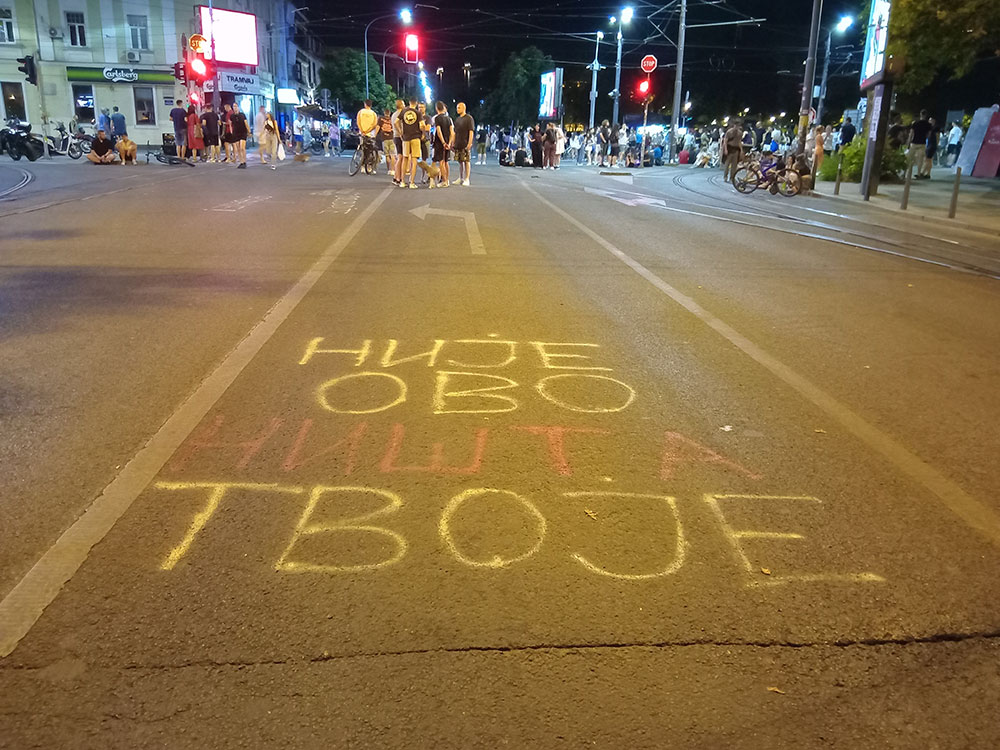
In the apparent lull at the close of summer and the uncertain start of yet another school year, as everyone waits to see whether Vučić will call an election or not, it’s inevitable that many will ask themselves: what has all this been for? What has the rupture in society over the past ten months—along so many already frayed seams—actually achieved? A movement that, with rare exceptions, only its opponents dare to call a revolution.
In our fixation on the exit point—elections—it’s worth remembering that a revolution, in the original (astronomical) sense of the word, is a continuous orbit. “Continuous” does not mean eternal—nothing is eternal, not even in astronomy—but one year, the length of Earth’s revolution around the Sun, is a useful measure of time.
Which suggests that the next two months are crucial. Not because they mark the anniversary of the collapsed canopy in Novi Sad, nor because the regime will use them to prove to foreign creditors that it can still deliver lithium, roads, the Expo, and any other natural resource they’ve already sold in advance (which is basically everything). Not even because, as students have long warned, these months will bring both open repression (police violence) and more subtle tactics (counter-protests, graffiti, infiltration). But because the outcome of these two months depends on what each of you does—today, tomorrow, and the day after.
The future, in other words, is what you are living right now.
The future does not depend on whom you vote for, nor on whether the SNS wins (as it likely will), nor on whether, in case of a deadlock, the opposition manages to unite (as it likely won’t). It does not depend on whether the EU abandons a single mining project in the region because its attention shifts elsewhere. Temperatures will keep rising, and there are countless other ways to pollute land and water alike, even through projects branded as “local” (let’s recall: state ownership does not guarantee fairness or sustainability in a country where even the state is treated as private property).
The future depends on whether, when offered more than €1,000 per square meter for land with a spring, you decide not to sell—no matter how many summer vacations in Turkey that money could buy (the answer: no more than three, since summers, if you can even get the time off for a vacation, will become unbearable). It depends on whether you stay in neighborhood assemblies, even if the neighbor from the third floor drives you mad. It depends on whether you form unions—not to keep digging while pocketing dividends (the model of privatization in the early transition years)—but so you can share the cost of childcare (or even set up a daycare at your workplace!) and lawyers when the more outspoken among you are arrested or illegally dismissed. Above all, the future depends not just on resisting open repression, but on resisting the velvet temptation of “normality,” where life is reduced to shopping and scrolling.
The future, in short, depends on you.
It depends on whether you choose to skip a protest because it’s the first day of school and there’s a football match on that night. It depends on whether you wake up too hungover from beer and cigarettes to join the 16 minutes of silence. It depends on whether, instead of organizing aid groups to share missing school supplies, you come home exhausted after standing in line for over an hour. It depends on whether, in your exhaustion, you order from Glovo and forget that its couriers—often migrants—risk their lives not only inhaling exhaust fumes but also biking through badly designed roundabouts. It depends on whether, a month and a half from now, sitting in traffic in exactly the same jam as during the blockades, you feel something has been taken from you—without remembering when or what.
That is the true meaning of revolution. Revolution is not about changing this regime or the next. The goal of revolution is not to swap one government for another: the goal of revolution is to make it irrelevant who governs. That is also the meaning of a social movement. It is neither “student” nor “civic.” Its goal is not to call elections, prosecute those responsible, or halt the sell-off of public assets, though all of these are useful signposts. The essence of the movement lies not in its destination, but in its capacity to move. Like a revolution, it belongs to no one—because it belongs to everyone.
The author is a social theorist and Associate Professor at Durham University in the UK, currently in Belgrade for training.
Translated by Marijana Simić
Peščanik.net, 06.09.2025.
- Biografija
- Latest Posts
Latest posts by Jana Baćević (see all)
- Dan kada je mama otišla malo da se skloni - 12/05/2026
- Nobody’s revolution - 06/09/2025
- Ničija revolucija - 04/09/2025