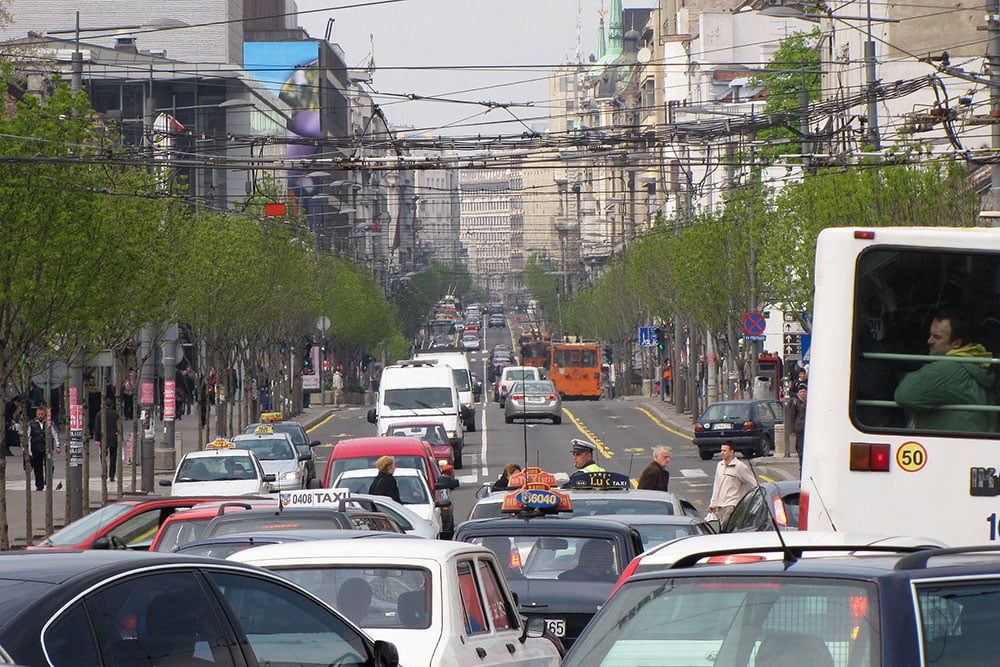
Belgrade has lost both its bus and train stations. People who are traveling to or coming back from somewhere are wondering what happened to space and time in the capital. Mayor Šapić will repaint the buses, trolleys, and trams in a Nemanjić blue. The color red unnerves him.
Tito did more damage to the Serbs than Franco did to the Spaniards. So says the ignorant mayor, leading the Chetnik invasion of Belgrade, although Vučić at least forbade him to dig up Tito’s remains and move them to Kumrovec.
Digging up is the word of the year, it seems. It applies not only to Tito, but also to lithium, the term that first poisoned the language. This text is not dedicated to mining, however, but to the phantom Belgrade metro.
My knowledge of metro systems is modest, except that I have seen them in some European cities. I convinced myself that it is still possible to do something like that. The legend about the Belgrade metro, which would perhaps make this city a metropolis, has been going on for more than 60 years. We first looked for the best, and then for just any solution. Belgrade’s underground is rich in mysterious waters and a large river flows under Terazije, circumstances which made things much more difficult.
There was never enough money or knowledge. Today, I am convinced that nobody even wanted Belgrade to get a metro. Each government shaped the city according to its own vision of urban planning, and yet despite all of them, Belgrade, at least in the 1960s, began to resemble a metropolis.
Back then, people knew where the train station was and where the bus station was. Passengers went down Balkanska Street, or walked downtown the opposite way. Traffic cop Jovan Bulj, who became a star because of the unique way he regulated traffic, stood on Terazije. People gathered to watch and applaud him. Tito was returning to Belgrade from his frequent trips and the people of Belgrade welcomed him with genuine enthusiasm.
Perhaps the best mayor in the history of Belgrade, Branko Pešić, did not have enough support to get the metro project approved. It is believed that the leadership of the state at that time, which came mainly from rural roots, didn’t want to go underground for any reason. And besides, traffic still flowed comfortably and without congestion.
A part of history that arose from wars, poverty and hatred, naturally left the metro on the back burner. When we became an unsafe part of the normal world again, and Belgrade became overpopulated and urbanistically destroyed, it became clear that the metro was needed to avoid the danger of the city becoming congested by itself. Again, no one knew how to do it, nor did they know people who did. Even if they did know somebody, they weren’t able to explain what was required of them. That’s how it seemed to us regular folks, anyway, curiously waiting for someone to start digging those tunnels, put pipes into them, and wagons into the pipes.
Then, when the Progressive government took office, they remembered the metro. No one managed to do it before us, they didn’t know how, but we do. That’s what Vučić said sometime in early 2014 and promised that the first metro lines would be ready by the end of 2016 at the latest. In April 2014, Serbia was hit by the “Biblical floods”, a circumstance that delayed everything, including the metro. Belgrade’s underground rivers flowed in the streets more and more often.
But then, in 2018, we were promised that the metro will start in 2021, and Aja Jung, ballet dancer and choreographer, handed out tickets for the first ride. We may not have a metro, but we do have tickets. This was a unique opportunity to travel in a train that does not exist. All the same, A. Vučić picked the passengers for his first ride, and for that occasion, a bus was remodeled and styled as a wagon, part of the metro composition. The chosen group, displaced from the surface into imagined dark spaces, traveled along an imagined line that may be built at some point. The leader explained to the lucky passengers in detail what the metro is and what ours will be like, and asked them to save their tickets for the near future.
The exact time when everything will start and end was set by Minister Siniša Mali on November 3, 2021. He said that construction of the first metro line will start in Makiško polje on November 22 of the same year. Mali said that the funding for the entire project was secured, and that a contract was signed with the Chinese company Power China. The dream of all Serbs going back more than 50 years will finally come true, and he quoted Victor Hugo, who allegedly said that “dreams create the future.” If it wasn’t for President Aleksandar Vučić, he said, we wouldn’t be here today. Three metro lines, he said, will be integrated with the further expansion of the BG train.
The start of the construction of the stations was planned for September 2023, and the digging of the tunnel for December of the same year.
Since then, Makiško polje has been covered in gravel in preparation for construction. And that’s all we have when it comes to the metro.
The newest mayor visited the dusty construction site in Makiško polje and said that the construction of the depot is progressing.
Goran Vesić said that the metro is the most important project of the decade, and managed to specify some other deadlines for the works. The tunnel-boring “mole” machines should arrive soon. Once they come, everything starts, we can’t manage without the moles. Expensive machine, that mole, but we got it.
Finally, the first passengers of the Belgrade metro on the line Makiš – Sajam – Trg Republike – Bogoslovija – Višnjički put – Mirijevo, or something like that, could board the train at an unspecified station on an unspecified day in 2028.
The wagons will be painted blue, they will move through the underground of the land of the Nemanjić dynasty and their descendants.
Those who know more than me say that nothing is being done about the matter and there is no hope that anything ever will be. The Belgrade Metro still exists, it is a company, it has around 300 employees, directors, bosses and foremen, who do – god knows what. The money set aside for that big thing, if indeed it was set aside, is being spent on more urgent matter. And we are still waiting for the moles.
The regime has evidently realized that the Belgrade metro is far too complex an undertaking for their capacities and intellect, redundant, unsafe and expensive. A political specter for a journey to the center of the earth, and a part of a great illusion. The tickets Aja Jung handed out remain a memory of something that never existed and never will.
Translated by Marijana Simić
Peščanik.net, 19.10.2024.
- Biografija
- Latest Posts
Latest posts by Ljubodrag Stojadinović (see all)
- Peščanik kod Cvetka - 23/10/2026
- Estradni nadražaji - 21/10/2026
- Nužne mere - 16/10/2026