

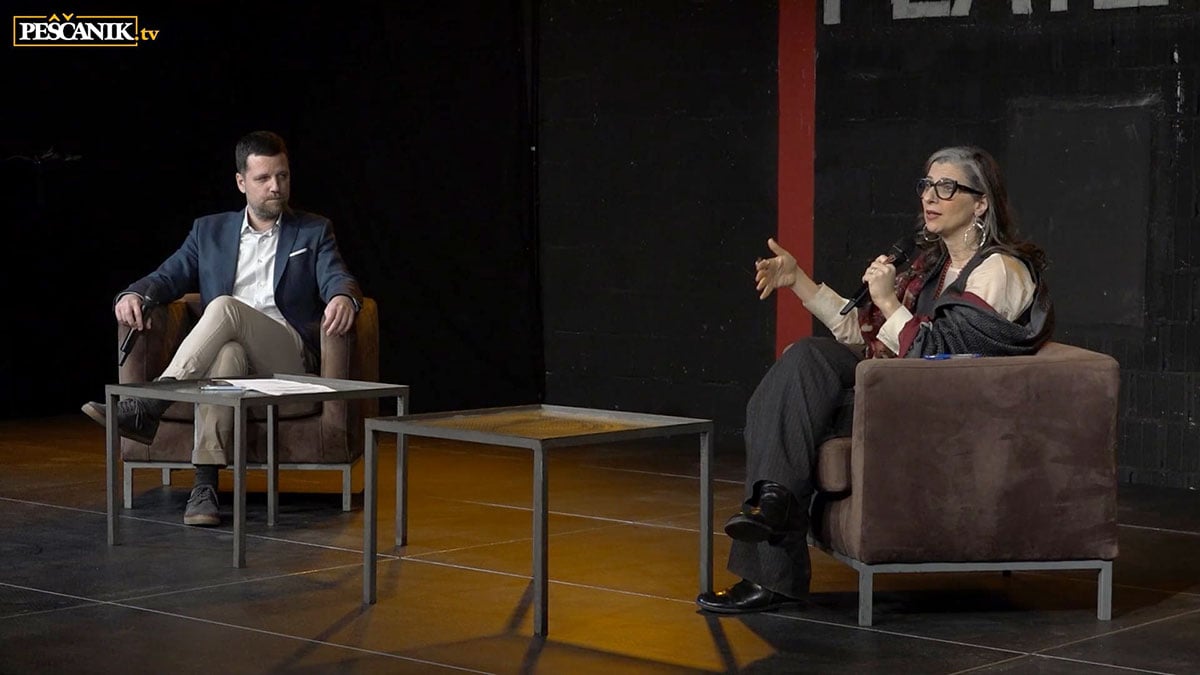
This is a condensed version of the public conversation with the United Nations Special Rapporteur on the occupied Palestinian territories, which was organized by the Olof Palme International Center and the SOLIDAR Foundation, at Dorćol Platz on March 17, 2026. Moderated by Filip Balunović. Full video of the event. Complete transcript of the conversation in PDF.
Dehumanisation is one of the root causes of crimes committed against a collective people, and I cannot recall a single moment in the past hundred years during which Palestinians were not subject to it. It began with the British, who arrived to their land having made conflicting promises – including the promise of independence in exchange for fighting the Ottomans – and then betrayed those promises. In 1922, the League of Nations authorised Britain to help create a national homeland for Jewish people in Palestine, and in doing so the Palestinians were effectively rendered invisible within the very document that defined their territory: in international discourse, they became the “non-Jews of Palestine”.
This invisibilisation has taken many forms since. Golda Meir famously declared that Palestinians did not exist, while her own first passport bore the word “Palestine” on its cover. Over time, Palestinians were reduced to categories such as “refugees”, “people in the occupied territories”, and today “Ghazawi” – as if Gaza were their origin, when in fact 75% of its population comes from what is now Israel, displaced during the ethnic cleansing of 1947–49. As Edward Said put it, Palestinians are “orphans of a homeland that existed and is no more”. They have reconstituted themselves as a people despite this, but have been treated not as a protected population under occupation, but as an encumbrance to be uprooted – made killable, displaceable, torturable. In fifty-five years of occupation prior to 2023, nearly a million Palestinians had been detained at least once.
Dehumanisation is the constant premise of an oppressive regime. Apartheid is built upon it. Genocide is made permissible by it. One Israeli soldier, when asked why soldiers would arrest and beat children, responded with a question of his own: “Which children?”, because in that framework, Palestinian children are not children; they are, at best, “young adults” and “terrorists in the making”. This is the logic that has enabled what followed.
What happened on October 7 ignited fear and rage in Israeli society that has not subsided. But to speak only of October 7 is to misread history entirely – it is more accurate to say we are living through nine hundred days of October 7 as a permanent mindset, rather than nine hundred days from it. The deeper context is a settler-colonial project, one that would not have been possible without the active support of colonial powers.
In 1948, between 51 and 54 states constituted what we call the international community – while three-quarters of the world’s population still lived under colonial rule. The partition of Palestine, which gave 55% of the land to the Jewish state despite Jewish ownership of roughly 6% of it, followed the same logic that had already been tested in this part of the world: dividing people along ethnic lines. It did not work in India and Pakistan. It did not work in Palestine. During the Nakba, five hundred villages were erased, and more than fifty massacres were committed. An entire civilisation was destroyed.
We should stop telling ourselves the comforting story that after the Second World War the international community simply decided to be good and embraced human rights. That is not what happened. It took Germany decades to acknowledge what had been done to the Jewish people. The United States and Great Britain were turning back boats full of Jewish refugees even as the war ended. The Universal Declaration of Human Rights was possible because there were good people inside the system – but good intentions and political reality are not the same thing. The rights we now consider universal were not gifts from states; they are the recognition of the sacrifice of those who fought and died to correct injustice. Decolonisation did not happen on its own will. Apartheid did not end on its own will. Change has always required people willing to push the boundary of what is permissible.
The Genocide Convention, in Article 2, defines genocide as the intent to destroy a national, racial, ethnic or religious group – in whole or in part – through specific acts: killing members of the group; causing serious bodily or mental harm; deliberately inflicting conditions of life calculated to bring about physical destruction; preventing births; and forcibly transferring children.
What is happening in Gaza satisfies each of these criteria. Leaving two million people without food, water, electricity, or medicine, while carpet bombing them and directing them from one place to another only to bomb them there as well, constitutes the deliberate creation of conditions calculated to destroy. The destruction of the health system – through the bombing of hospitals and the killing of over a thousand doctors, nurses and medical workers – does not merely harm the present population; it removes the capacity of any future society to rebuild. Twenty thousand children killed by bombs, sniper fire, or trauma within five months. The same number left orphaned. The same number left with at least one limb missing. Seven hundred infants rendered permanently limbless before they ever crawled.
Genocide requires what lawyers call “double intent”: the intentional commission of acts that are crimes in themselves – killing, torture, starvation – combined with the intent to destroy the group as such. Genocidal intent cannot be inferred solely from the words of perpetrators; it is recognised from the identity of the victims. They have only one thing in common: belonging to the group targeted for destruction. Whether they are women or men, old or young, doctors or farmers, sleeping or praying or fighting – they are treated identically, as an encumbrance to be eliminated.
Genocide is also a process. It requires planning, dehumanisation, and execution. In January 2024 the International Court of Justice – citing its own jurisprudence from Bosnia v. Serbia – established that from the moment there is a credible signal that acts of genocide may be committed, states with influence have an obligation to intervene and prevent it. Nothing of the kind has occurred. Far too many states continue to deny that a genocide is taking place, and some are profiting from it.
Under international law, states are not free to transfer weapons to whomever they choose. A state accused before the International Court of Justice of genocide – as Israel is – triggers an obligation upon all member states not to transfer weapons, and not to aid or assist in any way. Beyond the genocide proceedings, the ICJ has already declared the Israeli occupation itself to be unlawful, and has stated that member states cannot engage with it until Israel withdraws its troops, dismantles its colonies, and allows Palestinians to return. Any weapons transfer to a state maintaining an unlawful occupation through military rule is therefore a violation of international law, regardless of how the genocide question is ultimately resolved.
What is happening in Gaza is not solely Israel’s doing. Over sixty states have provided political, military, economic, and ideological support to Israel throughout this period. Gaza is, in that sense, a collective crime – it bears the fingerprints of all of us, through our governments.
Countries that are selling weapons to or purchasing weapons from Israel – including several European governments – are violating international law. Some of them, simultaneously, have suppressed freedom of expression and freedom of association at home, criminalising protests in which citizens demanded an end to a genocide. In my own country, Italy, legislation is being considered that would effectively conflate criticism of the state of Israel with antisemitism – meaning that what I have said publicly would constitute a crime. This is the connection: a system linking centres of power to Israel, a system in which the genocide could not be committed without external complicity.
This genocide is not going to be stopped by the current governments. That needs to be said plainly. But the arc of history has never bent toward justice on its own – it has always required people willing to act.
Citizens can boycott and must boycott. Israel has long maintained what can only be called an economy of occupation – one that has, over the past two years, become an economy of genocide. While thousands of Israeli businesses were shutting down and parts of the population were being displaced, the Tel Aviv stock exchange rose by 213% compared to its level in late September 2023. The private sector – construction companies, surveillance technology firms, banks, pension funds, and major tech corporations including Google, Amazon, and Microsoft – is structurally embedded in the occupation. Products connected to the occupation must be refused, and pressure must be placed on businesses involved in this economy. Savings – even modest ones – must not be invested in war-related activities. The technologies of containment and surveillance developed and tested against Palestinians will not remain there; they will be used against others, including refugee and asylum-seeker communities in Europe.
Countries like Spain and Slovenia have demonstrated that principled action is possible. Spain has seen lawyers sue companies involved in building Israeli infrastructure in the occupied territory; dock workers have refused to service goods directed toward the occupation; scholars and civil society have acted in concert. These governments have been able to take stronger positions in part because they had strong, sustained civic pressure demanding it.
To the Serbian audience specifically: this country and its people have experienced the torment of dehumanisation across history. Serbia has already been associated with genocide once. That is precisely the reason to stand against this one – not because it is demanded from the outside, but because it would mean something to claim that position from experience. Scholars, constitutional experts, journalists, activists and ordinary citizens each have a role. Sustaining that action collectively – as a body that functions with one brain and one heart – is the test that this moment places before all of us.
If we do not meet it, the world waiting on the other side of this genocide will be considerably worse than the one we inhabit today. But if we do, we will have earned the right to say that we emerged from it more human than we entered.
Edited by Milica Jovanović
Peščanik.net, 23.03.2026.


