

The statement above, probably made by a well-intentioned but simple man, was once dug up and often quoted by the late Vojin Dimitrijević. It shows how widespread and terrible the stigma that the very word “genocide” (the killing of a people) carries with it. International lawyer and specialist in this crime, William Schabas, euphemistically calls it “the G-word”, and also talks about the omnipresent “mystique of genocide”. The G-word is relatively new, coined in imitation of already existing ones: “suicide”, “patricide” and others. We know precisely who coined it, and when: Polish lawyer Raphael Lemkin, in a private letter in 1942, and the word was first printed in 1944, in his book Axis Rule in Occupied Europe.
Lemkin invented a new word because no existing word could describe the previously unimaginable crime the Nazis committed against the Jews. But “genocide” was not a crime in the legal sense for a long time after that, i.e. It was not defined as a criminal act. It became so only in 1951, when the Convention on Genocide, adopted by the United Nations in 1948, entered into force. Until then, no one could be convicted of genocide, no matter what heinous crimes they committed against the members of an ethnic (or other, in the sense of the Convention) group with the intention of destroying it. Likewise, no one who had already committed such a crime before January 12, 1951 could be tried or convicted of genocide. That is why those who carried out, ordered, and facilitated the extermination of Jews in Europe during the Second World War were never tried for genocide. If he had survived, Hitler, together with Göring, Hess, Keitel and others, would have been convicted in Nuremberg for crimes against peace and humanity, as well as war crimes, but not for genocide. Adolf Eichmann was also not tried for genocide in Jerusalem in 1961, nor Andrija Artuković in Zagreb in 1986.
There were no trials for genocide until the international criminal tribunals of the United Nations were established – the one for the former Yugoslavia (1993) and the one for Rwanda (1994). The first man ever convicted of genocide was Jean-Paul Akayesu, the mayor of Taba, Rwanda, who was sentenced on September 2, 1998, and entered into force in 2001. And the first person convicted of genocide in the former Yugoslavia, more precisely in Srebrenica, was Radislav Krstić, general of the Army of Republika Srpska. After Krstić, Ljubiša Beara (chief of security of the Main Staff of the VRS), Zdravko Tolimir (Beara’s assistant), Vujadin Popović (lieutenant colonel of the Drina Corps of the VRS), Radovan Karadžić and Ratko Mladić were convicted of the same genocide. It should be emphasized that no one was convicted of genocide “in Bosnia”, i.e. in other cities and regions of Bosnia, although Karadžić and Mladić were also accused of that.
In a sense, the verdict against Krstić constituted the Srebrenica genocide. Until that ruling entered into legal force, it was possible to speculate and debate whether or not the genocide happened. For example, one of our lawyers believed that the crime in Srebrenica was not genocide – at least that’s how he interpreted the Convention. He remained of that opinion both before and after the first-instance verdict against Krstić (August 2, 2001), until the second-instance panel passed the final verdict, on April 19, 2004. But, from that moment on, the question of whether the genocide happened was no longer raised: it was settled by a court verdict. No event is a genocide because a lawyer (or a layman) thinks so, but because it was determined by a competent court in a prescribed procedure.
The Tribunal for the former Yugoslavia established that genocide was committed in Srebrenica and established the individual responsibility of a number of perpetrators. However, another court – the International Court of Justice, as the highest judicial body of the OUN – also confirmed the existence of that genocide. This was done in the proceedings on the lawsuit of Bosnia and Herzegovina against Serbia (then: FRY, then the Federal Republic of Serbia and Montenegro), in which the court had to determine whether Serbia was responsible for: (1) the execution of genocide, (2) complicity in the execution of genocide, (3) failure to prevent genocide and (4) failure to punish perpetrators of genocide. The verdict of February 26, 2007 established that Serbia is not responsible for execution or complicity, but that it is responsible for not preventing the genocide and not punishing its perpetrators. The court reiterated that there was no genocide “in Bosnia”, but only in Srebrenica, and rejected B&H’s request for damages from Serbia.
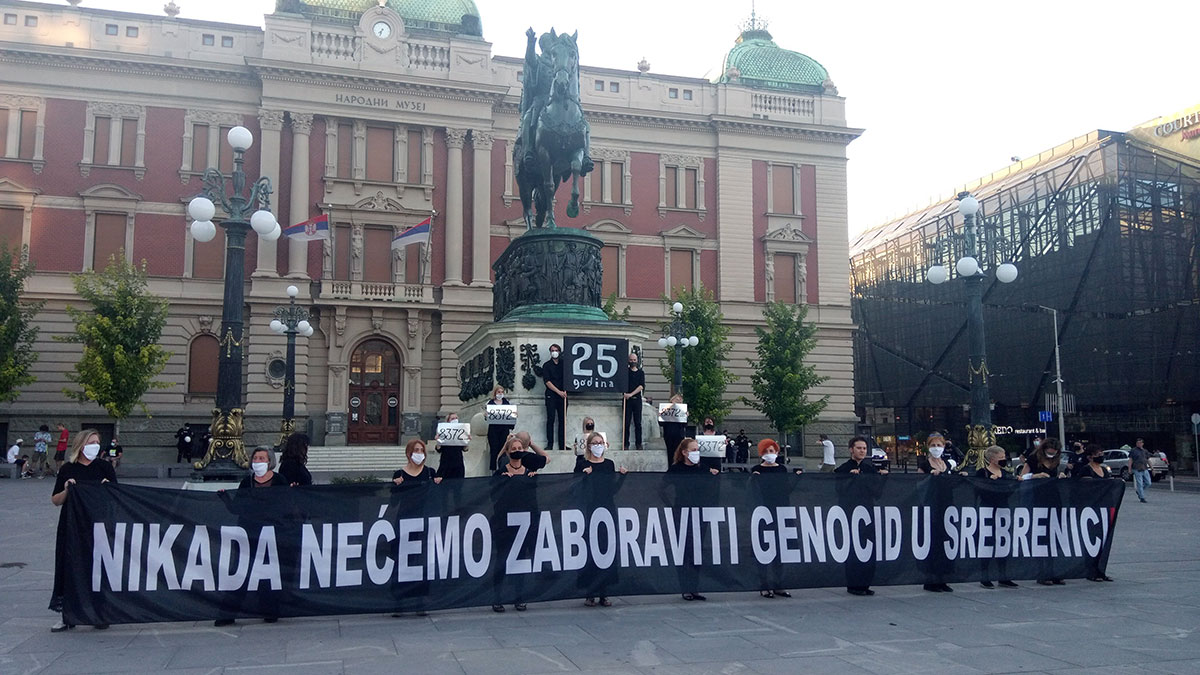
Finally, Serbia itself confirmed, although not by saying the word, but only indirectly, that genocide was committed in Srebrenica. It did so on March 31, 2010, with the Declaration of the National Assembly, which “strongly” condemned “the crime committed against the Bosniak population in Srebrenica in July 1995, in the manner determined by the verdict of the International Court of Justice.” And, as we have seen, the verdict of the International Court of Justice determined the genocidal nature of that crime and it was declared genocide.
Nevertheless, denial of the genocide prevails in political and general public speech in Serbia. Vojin Dimitrijević referred to those who deny the genocide as genocidals, and recently a strikingly similar term has entered common usage for those who do not deny the genocide, but rather admit that it occurred – genociders. The latter term covers both those who admit to the existence of the genocide and those who actually perpetrated it, but – at least when Milorad Dodik uses it – also includes their immediate and distant descendants, as if acknowledging and/or committing genocide is a hereditary trait: Dodik will not “let my grandchildren be genociders”. No punishment is too severe for those who recognize genocide. Vojislav Šešelj, who says that he has been “a prominent abolitionist [opponent of the death penalty] for decades”, was ready to support the introduction of the death penalty in 2019, but only on the condition that it be prescribed “for all those who declare that a genocide happened in Srebrenica”.
Genocide denial floods the public discourse every now and then, for a variety of reasons. The latest, ongoing flood was caused by a proposal that the General Assembly of the United Nations pass a resolution declaring July 11 as the “International Day of Remembrance and Commemoration of the Genocide in Srebrenica”. In the proposed text, neither Serbs nor Serbia are mentioned as being responsible for the Srebrenica genocide. Announcing Serbia’s no-holds-barred fight against that proposal, Aleksandar Vučić revealed the strategy that Serbia plans to implement if the resolution is passed.
The announced “strategy” is the epitome of infantile behaviour. If the resolution is adopted, Serbia will apply to become a non-permanent member of the Security Council. When it becomes a non-permanent member, it will strike back at the dark power behind the resolution, which is Germany. (In other words: if wishes were horses then beggars would ride.) As a non-permanent member of the Security Council, we will strike back by submitting proposals for resolutions to declare international days of remembrance and commemoration of genocide in Kragujevac, Kraljevo, Jajinci and Jasenovac every year. And the peak of perfidy of the Serbian strategy is that these resolutions won’t mention who is responsible for these “genocides”. But we will all know that those responsible were Germans and Croats!
Vučić is, of course, cynically aware of the childishness and silliness of this “strategy” and uses it solely as a distraction. Not only does Serbia not have to be a non-permanent member of the Security Council in order to propose resolutions to the UN General Assembly – every member state can do that, including Serbia today. It is more important that all the “genocides” that Vučić mentions are, in fact, war crimes from the Second World War and that the Germans and Croats responsible for them have already been convicted and punished as war criminals. Few people in today’s world know about the events in Kragujevac and Kraljevo in 1941, or in Jajinci and Jasenovac in 1941-1944. But many know what happened in Srebrenica in 1995. And what happened in Srebrenica was a genocide, established by the verdicts of the International Criminal Tribunal for the former Yugoslavia and the International Court of Justice.
Translated by Marijana Simić
Peščanik.net, 16.05.2024.


