

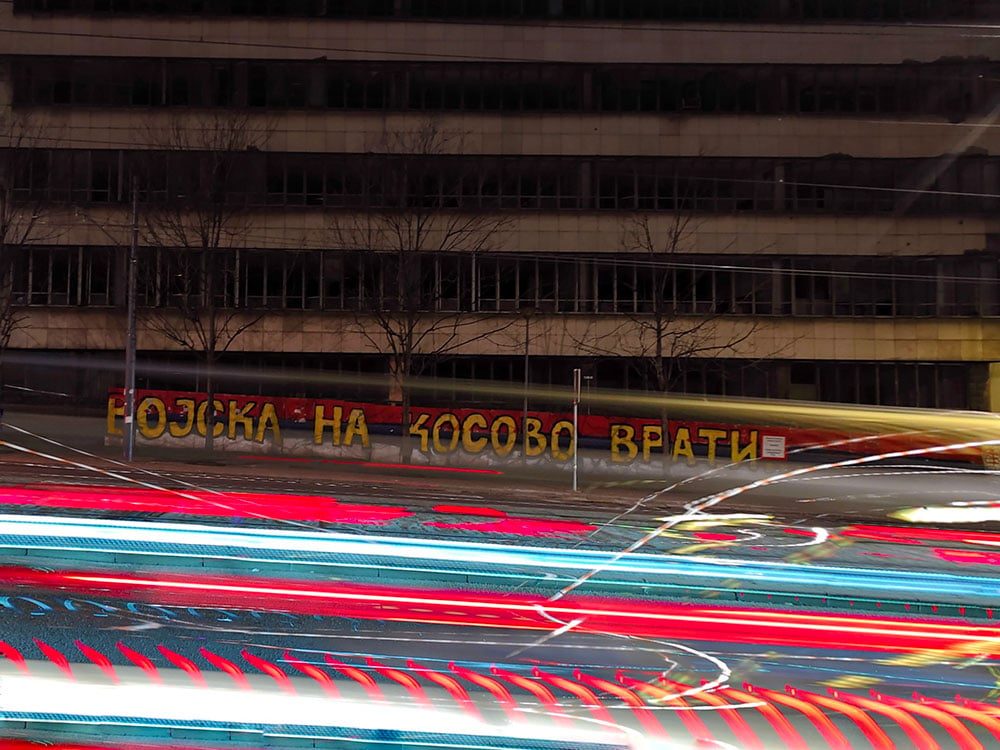
Had she been in Slobodan Milošević’s place in 1998, Snežana Paunović says she would have cleansed Kosovo of Albanians. The person in question, who spoke to Kurir about the historical undertakings of the Serbian people that were started but never completed, is, incidentally, a minister in Đuro Macut’s government. In expressing her regret over the unrealized ethnic purge of Albanians, Paunović invoked the hypothetical possibility of becoming the reincarnation of Milošević in that less-than-glorious chapter of history and carrying out what he did not. It is not that he did not want to. He simply did not get the chance.
Minister Paunović carries Milošević’s political genes with her and entered the government representing Ivica Dačić’s party. That political group long ago dissolved into the Serbian Progressive Party (SNS), lost its distinctive identity, and has been slowly burning out ever since. By voicing Milošević’s unrealized vision of an ethnically Serbian Kosovo, Paunović indirectly points to what she sees as his lack of strength and determination to do what, in her view, had to be done. This is why she indulges in the fantasy of personality transfer and laments that she was not in his position at the time.
In her journey through history, Paunović somewhat glosses over important elements of the melancholy myth of Serbia’s sacred land, but she attempts to assess the role of the leader (herself) in an unrealized criminal project. Many ideas and crimes were in fact carried out, yet a minister in the government of modern Serbia now openly concludes that Milošević failed to do everything that needed to be done. Only that final step was missing.
Where has this monstrous lament over the failure to carry out ethnic cleansing in the past suddenly come from? That past has not ended in Serbia, although some processes related to Kosovo have nevertheless become irreversible.
The minister, who was born in Peć, says she would not define her life’s work through killings. Instead, all Albanians would have been (forcibly) sent to their home countries (!). Such departures cannot occur without expulsions and deportations. Terrorists, of course, would have been physically eliminated, and everything would have been resolved thoroughly and cleanly. Somewhere in this lies the source of Snežana Paunović’s sorrow and anger, behind her public mourning of this unrealized national project on Kurir.
Macut’s (Vučić’s) minister, in a sudden flare-up of nationalist chauvinism, has placed at the center of the debate the key idea of a “final solution.” Nothing, in this view, prevents Kosovo from being the heart of Serbia except for the Albanians who live there. They are never taken into account whenever the fate of Serbian Kosovo is discussed.
That would undoubtedly also be the central theme of the so-called “Serbian World,” in which there is no place for others. The current ruler agreed to everything in order to supposedly concede nothing, and from that chaotic political philosophy emerged the outlaw-terrorist incursion led by Milan Radoičić. It was an objective display of the new Kosovo heroes, perhaps the supreme commander’s last disastrous attempt as the head of the army, police, and criminal gangs alike, to do something for history.
Everything that has happened, turning the modern history of Serbs and Albanians into a terrible experience and making all political solutions a prolonged and dramatic agony, has not extinguished dreams of a more efficient past. The minister’s recollection of unfinished business is a reliable sign that, in some minds, the delusion about the effectiveness of great crimes has still not evaporated.
It seems that very few people in Serbia are prepared to face reality. Instead of empty declarations, pathetic curses uttered at traditional gusle gatherings, and invocations of romanticized warriors, efforts should be made to help Serbs and Albanians live together in a place that has, for decades, claimed lives because of territorial claims, hatred, and the delusion that coexistence is impossible. Achieving that requires the one thing that remains out of reach: reason.
The nostalgia for an ethnic cleansing that was never fully carried out, publicly preserved by Minister Paunović as the great failure of her life, points to a profound darkening of Serbia and the continuation of its broader social and political disintegration.
Translated by Marijana Simić
Peščanik.net, 21.07.2026.


- Biografija
- Latest Posts

Latest posts by Ljubodrag Stojadinović (see all)
- Peščanik kod Cvetka - 23/10/2026
- Estradni nadražaji - 21/10/2026
- Nužne mere - 16/10/2026
