

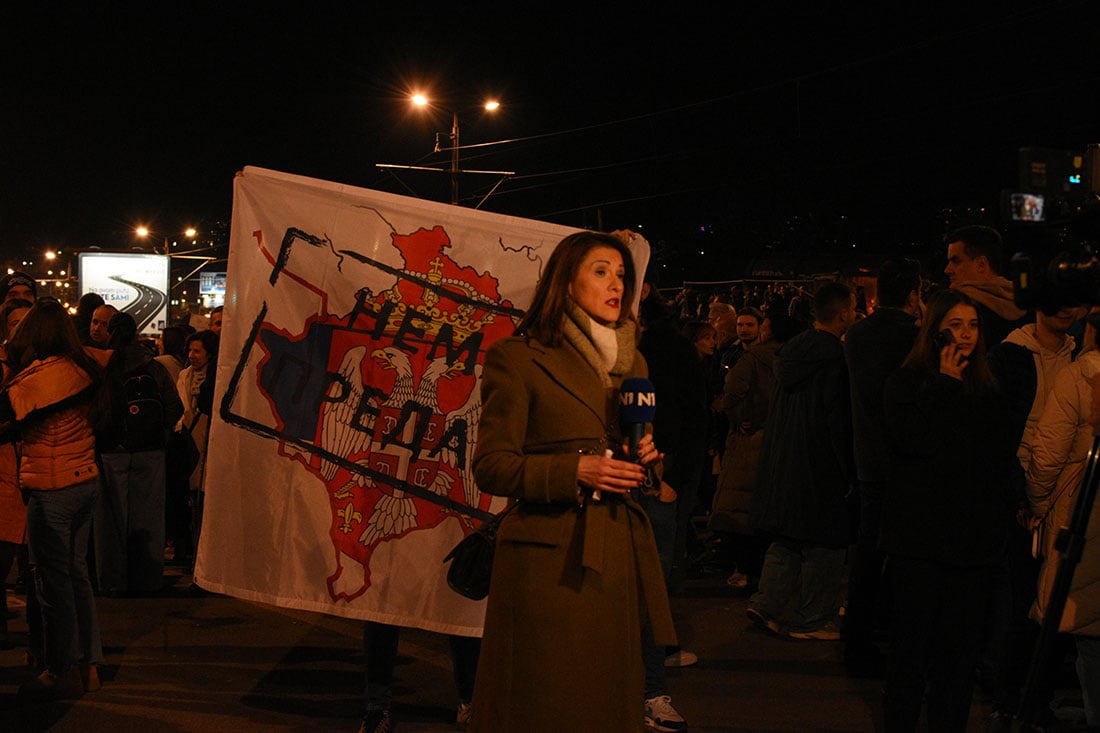
If it were only up to him, A. Vučić would make short work of N1. The creeping destruction of free media is unfolding in the dark and quite insidiously, with personnel support from the mercenary media. After the removal of Igor Božić, a certain lull followed ahead of the expected final blow. N1 is the leading source of frustration for the local strongman; he wants to eliminate any doubt about the reasons for his destructive grip on power.
By shutting down N1, Nova, Danas, and Radar, he might easily win elections. That is the logical outcome under conditions of absolute control over disinformation. Information ceases to exist if there are no means to deliver it to the political public and other consumers. His agitprop would temporarily become untouchable. Election results themselves could become irrelevant – he would only need to announce an unverifiable falsehood that he has won again. If there is no one left to publicly challenge it – and the goal is that there be no one – then everything unfolds and concludes in dense darkness.
This would be the diabolical epilogue of a blow that has been in preparation for years. The final killing of media outlets that stubbornly resist the suffocating stench of tyranny is not an entirely easy task, even for such an obsessively violent ruler. Although no one in the European Union would be overly shaken by Serbia’s descent into informational darkness. Protests in support of N1 have been unexpectedly weak.
Solidarity has been lacking among many who consider themselves important while surviving in a gray zone of apparent comfort. Free intellectuals in Serbia are effectively underground; only a score or so remain who speak freely. Some vocal opponents of the regime have suddenly fallen silent and disappeared. The Serbian Academy of Sciences and Arts is mired in its own futility and senile slumber. Informer has become a second royal throneroom and the center of the ruling party’s excesses – an unrelenting toxic spectacle that gathers within itself an enchanted underclass and turns it into a finished product for dystopia. A sycophantic media colony exalts its grotesque deity with all its might. The strongman is further equipping his praetorian troops for the continuation of terror.
The architects of that hell openly threaten that one day, and very soon, they will take over N1.
After Viktor Orbán’s devastating electoral defeat in Hungary, the perception of media here has shifted, at least slightly. Péter Magyar promised that he would abolish all television stations there that had “sown poison.” That is, of course, not his role, but the political defeat of an authoritarian ruler ultimately places in jeopardy the media, or their parodies, that served him.
The political fates of Orbán and A. Vučić are unfolding like parallel thrillers in which we see only villains and repulsive faces. One has fallen and is pulling the other down with him. The local autocrat was certainly shaken and frightened by the decisive defeat of his “brother and friend” Orbán, with whom, just three weeks earlier, he had staged an amateurish simulation of a terrorist attack on a gas pipeline.
Vučić’s fear of being defeated or overthrown is greater than ever. That fear might force him to hesitate in launching a final assault on N1.
Because the risk of eradicating the media could be greater than simply losing power. If he were certain of remaining in power for a few more years, he would already have ordered a change in editorial policy. And we would have Jovana Jeremić and “Mornings with the President.”
Under the pressure of time running out, he might call elections before the process of shutting down the media is complete, with the real fear that any delay could result in an even more devastating defeat.
Shutting down all media that are not to his liking would in any case leave him in an extremely difficult position after a defeat, which now appears very close. Unlike Orbán, he cannot avoid widespread and aggressive public outrage, outbursts of justified hatred, social ostracism, legal repression, and the loss of freedom. On top of all that, he is visibly worn out, and his physical and mental health are on a steep downward trajectory. He has to hurry, and haste kills.
Even if all independent media were shut down and, in the view of his loyalists, an idyllic single “truth” were established, the danger of a sudden fall would not be removed. The phenomenon of informational claustrophobia is well known – it manifests as a rebellious and often violent search for truth. When all possible outlets are forcibly sealed, implosion becomes the logical response to total terror.
By suffocating the media, A. Vučić would experience a final defeat that he is postponing by all means of violence. He might continue to exist in a state of decay for a while longer, but there would be no one left to tell him so.
Translated by Marijana Simić
Peščanik.net, 23.04.2026.


- Biografija
- Latest Posts

Latest posts by Ljubodrag Stojadinović (see all)
- Peščanik kod Cvetka - 23/10/2026
- Estradni nadražaji - 21/10/2026
- Nužne mere - 16/10/2026
