

“Don’t consider any insignia around me as mine. Only my veterans may be marked; I’m no longer interested in any other structure,” said Dijana Hrka last week, when she decided to end her hunger strike after 16 days.
She began the hunger strike to fight for her demands: for the release of students arrested during the protests, for all those responsible for the collapse of the canopy at the railway station in Novi Sad to be prosecuted, and for early parliamentary elections to be called. When she decided to end the hunger strike, Dijana Hrka – whose son Stefan died in the Novi Sad canopy collapse – said she was not giving up on her demands and would not leave the tent near the Serbian Parliament, where she had spent the previous 16 days.
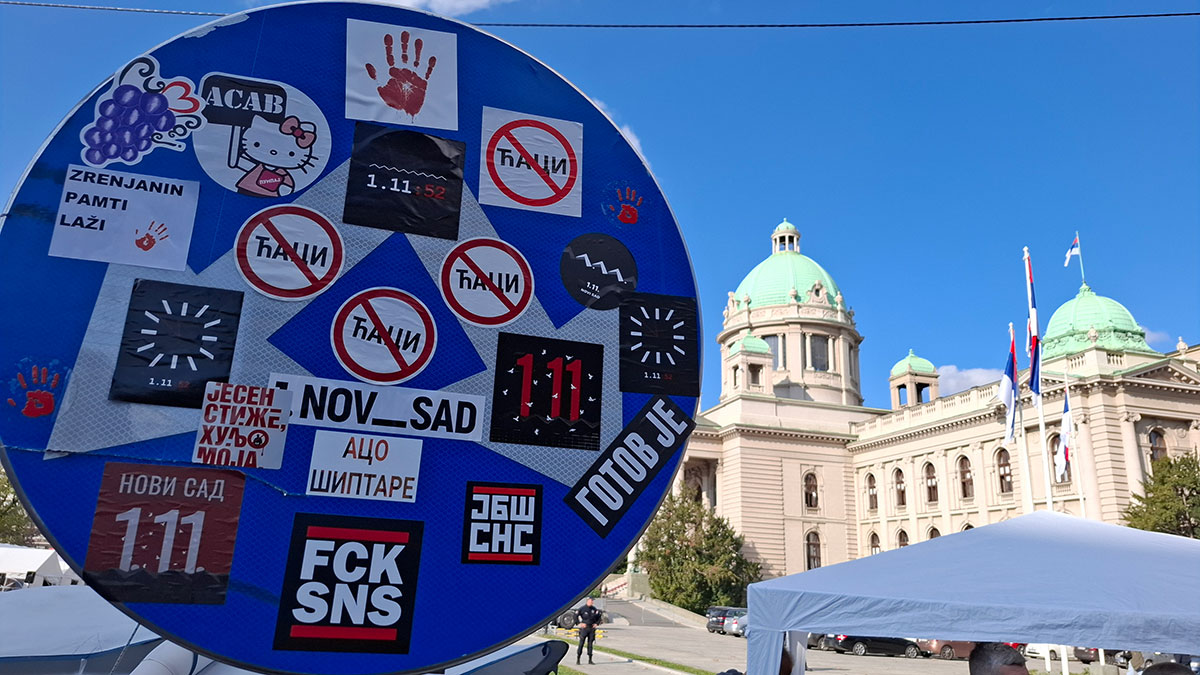
Between her tent and the Serbian Parliament, a fence has been set up, with a group of police officers standing behind it. And behind them is the so-called “Ćaciland,” made up of the square in front of Parliament and Pioneers Park, where supporters of the current government have been “camping” for months. Although the camp is allegedly for students who claimed they “just want to study,” anyone who has walked by the Parliament in recent months could see that the people sitting outside those tents are not just youth. There are also older people who regularly refuse to speak to journalists – likely because they know they’d be asked why they’re there and what exactly they’re trying to achieve, and they’re not sure what their answer would be.
Attempts to speak with them usually end calmly – provided the journalists approaching them don’t have visible markings of the outlet they work for. If they do, and they work for media not aligned with the government, they risk being attacked by Ćaciland “security” – something that happened a few days ago to an N1 television crew whose camera was broken, while Insajder journalists were previously physically assaulted. According to witnesses, the police just calmly watched the entire event unfold.
This is unsurprising, considering that for months the police have declared themselves “not responsible” for this now-restricted zone. When journalists ask if they can enter Pioneers Park and speak with any of the people there, they’re told to ask Ćaciland security – who, at least in my experience, refuse, explaining that the person who could authorize that is “not present.”
The impression held by part of the public – that Pioneers Park and the square in front of Parliament have become a shameful eyesore and embarrassment to the city – was confirmed on the day when, as a reaction to Dijana Hrka’s arrival and the beginning of her hunger strike, a song referencing “mother and son” was loudly played from within Ćaciland – an act that can hardly be understood as anything but mockery of the tragedy of a woman whose 27-year-old son was killed.
Dijana Hrka became known to the public when she stated that the state was responsible for the canopy collapse, after which she left Serbia for a while, because, as she said, she had been subjected not only to pressure from authorities but also to threats.
When she returned to Serbia, domestic media again took an interest in her, and once she began her hunger strike she became internationally known as well. Among others, Le Monde and The New York Times wrote about her, with the latter calling her the “mother of the (student) movement in Serbia.” This designation aligns with what Hrka herself has in some ways conveyed – that beyond seeking justice for the death of her son and the other 15 victims of the canopy collapse, she is fighting for the future of young people and all citizens of Serbia.
“I can’t say anything in advance. When the time comes, everything will be known. There will be activities, maybe not tomorrow or the next day,” Hrka said a few days ago, once again showing that she intends to actively participate in organizing actions that form part of the student and civic movement – and to be a figure around whom supporters of her demands can rally.
A huge number of Serbian citizens supported Hrka, but not in the way pro-government tabloids tried to frame it – claiming that citizens were supporting her “to endure” the hunger strike and sacrifice her life. They supported her because they saw in her the symbol of the 16 victims of the canopy collapse and their families. By gathering near the tent where she stayed, they wanted to express empathy and be with her, even though many gently told her they believed she should end the strike.
If the impression that Hrka is ready to become a “mother” or symbol of a rebellious Serbian society proves true – and especially if she succeeds – then every word she speaks becomes significant, because she would no longer represent only herself, but all those she seeks to unite.
Her statement “Only my veterans may be marked” therefore carries enormous weight, given that it was spoken in a country that, 30 years ago, participated in wars during which mass war crimes were committed.
Among the war veterans who became known during the protests is Goran Samardžić, who, addressing students in front of RTS this April, said he belonged to a generation that had fallen for warmongering propaganda against Bosniaks in Bosnia and Herzegovina – where around 100,000 people were killed. He accused RTS of spreading that propaganda, calling it a “kitchen of lies and hatred.” He emphasized that there is no longer such a thing as “our and their children,” saying that students from Novi Pazar are “our children.”
He has become a symbol of those veterans who, unlike many of their fellows, express a desire to take part in what the NGO Center for Nonviolent Action calls “peacebuilding.” That organization, which has worked with veterans willing to join the peace movement for years, points out in its book We Come in Peace that some veterans’ associations in the region still “nurture ethnonationalist identities and behaviors.”
Precisely because of this, Hrka – who now has the opportunity, or perhaps the wish, to become a symbol of a rebellious society in Serbia – and those who support her unconditionally, must keep in mind what her words might lead to. Not only because wars were fought in the former Yugoslavia 30 years ago, but also because in 2003 an assassination was carried out against Prime Minister Zoran Đinđić, for which, among others, Special Operations Unit (JSO) officer Zvezdan Jovanović and JSO commander Milorad Ulemek “Legija” were convicted.
It is also troubling that during a protest in August, when asked by journalists how she felt about needing to be protected by war veterans, Hrka said: “Thank you to the veterans; I didn’t feel the need for them to continue protecting me, but they had a meeting and decided to do so. Legija said it was decided that way.”
One hopes this was a misunderstanding, and that Hrka was not referring to one of the organizers of Đinđić’s assassination, formerly an officer of the Serbian Volunteer Guard (SDG) commanded by Željko Ražnatović Arkan, whose members committed war crimes during the 1990s in Croatia, Bosnia, and Kosovo.
Anyone who speaks publicly should take responsibility for their words – especially someone who is emerging, or even positioning herself, as a key actor in organizing new protests in Serbia. Hrka’s statement “I don’t like the opposition” – explaining that during Dragan Đilas’s tenure threats were made against her sister who lost her husband – is also unwise, because she allows herself to dismiss the entire opposition in a country immersed in corruption, one of the many “achievements” of the thirteen-year rule of the Serbian Progressive Party and its coalition partners.
And finally – the chants of “Aco, Šiptare,1” which once again sent a message of hatred toward ethnic Albanians, and which Hrka led on the first day of her hunger strike – and which the government then weaponized against her and all its opponents – do not inspire hope that she can become an adequate symbol of resistance to the Serbian Progressive Party or help the movement that began a year ago achieve the necessary changes in Serbia. Instead of that chant, she might have, in the spirit of what Samardžić did when he called the students from Novi Pazar “our children,” invited members of the Albanian minority to join other citizens of Serbia in their fight.
Translated by Marijana Simić
Peščanik.net, 29.11.2025.


